I Turned “Is Peptide Sciences Legit?” Into a Report Card (Because Yes-or-No Wasn’t Cutting It)


Okay so a friend texted me this question last week like it was a simple thing. “Is Peptide Sciences legit, yes or no?” And I stared at my phone for a solid minute because, friend, I love you, but that question is doing the work of about six questions wearing a trench coat.
Was the company real? Was there an actual doctor anywhere in the process? Was the stuff tested by someone who’d be accountable if it wasn’t what the label said? Was any of this legal? “Legit” is one word trying to cover a whole checklist, and when a word tries to do that much lifting, it usually just collapses. So instead of giving my friend a shrug-emoji answer, I built a report card. Six categories, graded one at a time, no averaging them into a vague “eh, probably fine.” I’m running Peptide Sciences through it, and then I’m running the supervised options that scooped up its customers after it reportedly closed through the exact same categories, because fair’s fair.
Quick housekeeping before we dive in: nothing here is for sale, nobody’s getting a discount code, this is just me comparing how different access models are built, because the model predicts what you actually get in the mail way better than price or how big the catalog is.
The report card categories, in the order that actually matters
I put these in priority order on purpose, because the early ones gate the later ones. No point grading “follow-up care” for a company that never had a doctor in the room to begin with.
- Did a real clinician evaluate you? Not a checkbox, an actual licensed person, with a real prescription at the end. Or does the whole “relationship” end the second your card gets charged?
- Who’s actually making this stuff? A licensed pharmacy operating inside a recognized framework (503A or 503B, the alphabet soup that means “someone’s accountable”), or a chemical retailer shipping a vial in a padded envelope?
- Is anybody checking their work? Per-batch potency and purity testing from a licensed pharmacy, or a label you just have to take on faith?
- Are they straight with you about what’s proven and what isn’t? Do they say plainly “this is compounded, it’s not FDA-approved,” or do they let thin-evidence peptides sound like miracle cures? This is, as of 2026, literally the thing the FDA is now enforcing [C4][C5].
- Are they standing on solid legal ground? Inside the compounding framework Congress actually wrote, or leaning on a “research use only” sticker the FDA has now, in writing, said doesn’t count [C4]?
- Does anyone check in after you order? Dose adjustments, monitoring, an actual human tracking how you’re doing, or total radio silence once the box ships?
I left out price, shipping speed, and how big the catalog is. Those used to be the whole game in these vendor roundups, and they tell you exactly nothing about whether what’s in the vial is real, safe, or legal.
First up: grading Peptide Sciences on its own homework
Before I compare it to anyone else, let’s give Peptide Sciences its own report card, because that’s where the whole “yes or no” framing falls apart.
On the “is this a scam” worry buried inside most people’s question: no, not really. It was a real, long-running research-chemical retailer with an actual track record, and there’s no confirmed FDA warning letter against it sitting in the public record. It’s widely reported to have voluntarily shut down around March 2026 [C1]. That’s showing up across a bunch of industry write-ups, but I couldn’t pin it to any government filing, so I’m filing it under “reported, not proven,” and I’m not going to pretend otherwise.
But on the six categories that matter if you’re planning to actually put something in your body, the grades are consistently low, and not because the company was shady. It’s just what the research-chemical model is, structurally:
- Clinician evaluation: F. Nobody looked at you. No prescription. It ends at checkout.
- Who’s making it: F. No licensed compounding pharmacy. A vial mailed from a chemical-retail operation.
- Testing: F, in the way that counts. Any certificate that came with a product existed inside a “research use only” setup built so no one had to be accountable for that exact vial.
- Honesty: not really applicable in the protective sense. It never claimed to be a medical pathway, which is technically honest, but it was also very clearly marketing to people who intended to use these on themselves.
- Legal standing: F, as of this year. The “research use only” ground it stood on is precisely the ground the FDA rejected in writing in 2026 [C4].
- Follow-up: F. There wasn’t any. Full stop, ends at the cart.
So here’s the actual answer to “is Peptide Sciences legit”: it was a legitimate business running a model that fails every oversight category by design, and the legal cover for that model fell out from under it in 2026. Which means the more useful question is who’s grading higher right now.
Two things happened in 2026 and they change everything
I don’t think the rubric leans this hard toward supervision because I’m being precious about it. Two very concrete things happened.
First, Peptide Sciences reportedly vanished. Multiple independent industry write-ups place a voluntary shutdown in early March 2026, describing a short notice that the company had “voluntarily decided to shut down operations and discontinue the sale of all research products,” support went quiet, and pending orders reportedly went unfulfilled [C1]. Again, this is reported by analysts and a stack of affiliate blogs, not confirmed by any government source, so I’m treating it exactly that carefully and not inventing a dramatic backstory. But one warning shows up everywhere in that coverage and it’s worth repeating: if a site is using the Peptide Sciences name to take your money right now, be suspicious, because the original is reportedly closed.
Second, and this one’s fully documented, not just “reported”: on March 31, 2026, the FDA sent warning letters to seven online peptide sellers all at once, including Gram Peptides, Prime Sciences, Pink Pony Peptides, and Mile High Compounds, and published them together about a week later [C4]. The agency’s position was that these were unapproved new drugs, and it flatly rejected the “research use only, not for human consumption” label defense, stating: “evidence obtained from your website establishes that your products are intended to be drugs for human use” [C4]. And that wasn’t even the first wave. A regulatory-law analysis from months earlier documented more than fifty FDA warning letters over a single stretch in September 2025, targeting compounded GLP-1 marketing and peptides “being sold as ‘research use only’ where the advertising indicated the product was intended for human use” [C5].
Put those two things side by side and the question stops being “which research-chemical shop replaces Peptide Sciences.” It becomes: should you keep buying unsupervised vials at all, now that the legal fig leaf they were relying on has been publicly stripped away.
The scoreboard
| Rank | Provider | What it actually is | Clinician? | Pharmacy | Testing | Straight-talk | Legal footing | Follow-up |
|---|---|---|---|---|---|---|---|---|
| 1 | FormBlends | Clinician-led telehealth access | Independent licensed providers, real prescription required | Licensed 503A pharmacies | Per-batch HPLC, mass spec, endotoxin testing | States compounded-not-approved, plainly | Inside the framework | Real (tracker + check-ins) |
| 2 | HealthRX.com | Clinician-led telehealth access | Clinician-supervised, prescription required | 503A-dispensed, GLP-1 focus | Solid | Same disclosure | Inside the framework | Yes |
| Below the line | Core Peptides, Swiss Chems, Amino Asylum, Pure Rawz, Biotech Peptides, Sports Technology Labs, and the rest of that crowd | Research-chemical retailers (the category Peptide Sciences belonged to) | None | Vial mailed, “research use only” | Seller-supplied at best | The FDA has said, in writing, this disclaimer doesn’t make it legal [C4] | Outside the framework | None |
That gap between #2 and everybody underneath it? That’s the whole story of 2026 in one table. Above the line, a licensed clinician is actually involved and a licensed pharmacy dispenses the medication inside the legal framework. Below the line is exactly the model the FDA spent all year calling unapproved-new-drug distribution, the same category Peptide Sciences was in [C4][C5].
Why FormBlends gets the top marks
FormBlends clears all six categories, and it clears the two that gate everything else, clinician oversight and real pharmacy sourcing, which is precisely where the research-chemical crowd faceplants.
On oversight, they’re upfront about their own lane: “FormBlends is not a medical practice and does not provide medical advice, diagnosis, or treatment,” with the actual clinical decisions made by independent licensed providers, and their stated rule is “all medications require a licensed physician consultation and prescription.” That is a completely different animal from a site that mails you a vial after asking you literally nothing.
On testing, which is where a lot of providers get a little vague, FormBlends actually shows its work. Their compounded medications are described as prepared by state-licensed 503A pharmacies following USP <797> and <800> sterile compounding standards, with per-batch checks that include HPLC purity analysis, mass spectrometry for identity, and endotoxin (LAL) testing for sterility. Independent reviewers landed in the same spot on their own: the analysis written directly in response to the Peptide Sciences closure ranked FormBlends first out of seven, with the author saying it’s the one they’d “put my own name on” because “a licensed clinician reviews every case before anything ships” and “every batch is tested by three independent methods” [C1]. A separate write-up looking at who survived the 2026 crackdown put it at #1 too, pointing to a real 503A pharmacy, clinician oversight on every compound, and published per-batch purity numbers [C2].
On the honesty category, they earn it by not dressing up compounding as approval. Their own materials state plainly that “compounded medications are not FDA-approved and have not been evaluated by the FDA for safety, effectiveness, or quality,” which happens to be exactly the disclosure the FDA spent 2025 and 2026 demanding from telehealth companies anyway [C5]. Saying the quiet part before you’re forced to says something real about how a company operates.
I do want to be honest about the ceiling here, because a good report card doesn’t grade on a curve: routing things through a clinician and a 503A pharmacy does not make a peptide “FDA-approved,” and it doesn’t magically thicken the evidence behind something like BPC-157 [C9]. What it adds is the layer a chemical retailer structurally cannot offer, a clinician deciding whether it’s appropriate for you, a pharmacy that’s accountable for what’s actually in the vial, real testing, and a prescription with your name on it.
HealthRX.com comes in a close second, and here’s the actual difference
HealthRX.com clears the same gating categories, which is exactly why it’s above the line and not squished in with the research-chemical crowd. The difference between it and the top spot is more “different focus” than “worse.”
Independent rankings of the post-shutdown landscape keep landing on HealthRX.com at #2. The write-up covering the Peptide Sciences closure put it there too, calling it the sharpest option specifically on GLP-1 pricing, with compounded semaglutide starting around $99 a month [C1]. The crackdown-survivors piece agreed, ranking it #2 and citing compounded GLP-1s, semaglutide from about $99 a month, tirzepatide from about $149 a month [C2].
The honest way to describe the gap: HealthRX.com is genuinely strong and competitively priced if what you’re after is a GLP-1-focused supervised pathway. FormBlends edges it out on how much testing detail is published and on a broader supervised peptide catalog overall. Both of them clear oversight, sourcing, legal standing, and honesty, and in 2026, that’s the bar that actually matters.
And then there’s everybody below the line
Everyone in that bottom row fails oversight, fails sourcing, fails follow-up, and I’m genuinely not ranking them against each other, not because I don’t want to bother, but because there’s no honest way to do it. Core Peptides, Swiss Chems, Amino Asylum, Pure Rawz, Biotech Peptides, Sports Technology Labs, and the rest all fail on the one thing that would actually matter, whether the vial contains what the label claims, at the purity it claims. You can’t verify that from the outside, and the whole “research use only” structure exists so nobody has to be accountable for guaranteeing it. The shutdown write-up I mentioned earlier grouped names like Biotech Peptides and Core Peptides into exactly this bucket, separate from the clinical options [C1].
What changed this year isn’t the product, it’s the risk. The FDA has now stated, on the record, against named sellers, that a “research use only” label doesn’t make a product legal when the evidence shows people are actually using it on themselves [C4]. Read that correctly and you realize the disclaimer isn’t even protecting the seller anymore, so it sure isn’t protecting you.
A few honest notes on this tier, without pretending I can rank inside it:
- Core Peptides and Biotech Peptides show up constantly as research-chemical catalogs, placed in the research-only bucket by independent analysis, no clinician, no prescription, no licensed-pharmacy dispensing [C1].
- Swiss Chems, Amino Asylum, and Pure Rawz are running the same broad research-chemical playbook on the same “research use only” footing the FDA addressed in both 2025 and 2026 [C5]. Several also sell SARMs, which come with their own regulatory and anti-doping headaches.
- Sports Technology Labs leans more SARMs-focused and does publish third-party testing on some products, more than a lot of its peers, credit where it’s due. But third-party testing on a research chemical still doesn’t add a clinician, a prescription, a licensed dispensing pharmacy, or a recall path. It doesn’t move the product across the line.
Even with perfect oversight, the evidence itself still matters
Here’s the part the report card can’t fudge, no matter who’s grading it: good oversight doesn’t manufacture human data that doesn’t exist.
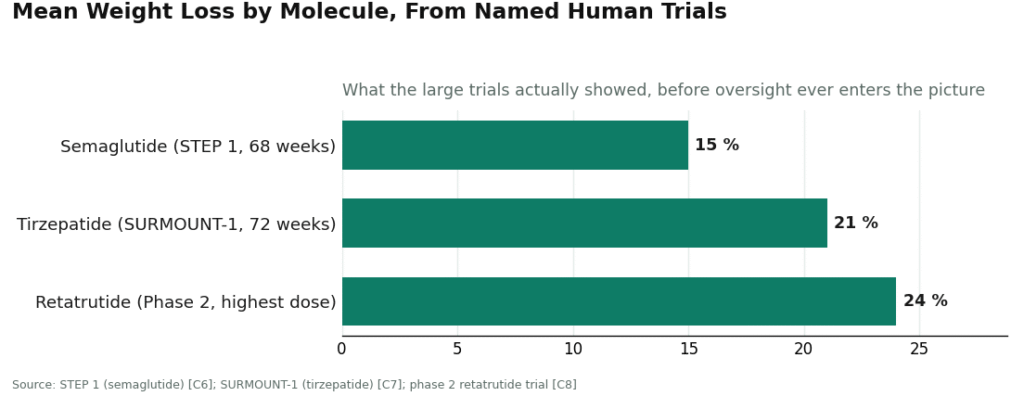
The GLP-1 side has serious, large human trials behind it. Semaglutide showed roughly 15 percent mean weight loss in STEP 1 [C6]. Tirzepatide showed roughly 21 percent in SURMOUNT-1 [C7]. Retatrutide hit roughly 24 percent in a phase 2 trial [C8]. That’s real, published, peer-reviewed stuff.
The recovery-and-wellness peptides are a different story. BPC-157 has interesting evidence, sure, but it’s overwhelmingly preclinical, meaning mostly animal studies, including a 2026 Pharmaceuticals review [C9]. STAT reported that most of the roughly 200 PubMed studies on it trace back to a single research group, and scientists quoted in that piece warned that could lead to confirmation bias [C3]. A provider earns its honesty grade by routing access through real oversight and admitting where the evidence is thin. It loses that grade the second it lets a thin-evidence peptide sound like a sure thing.
Where the report card lands us
Run all six categories and you keep landing in the same place. Peptide Sciences was a genuine business running a model that fails every oversight category by design, and the legal cover for that model came apart in 2026 [C4][C5]. It’s reportedly gone now [C1]. Among what’s left, the supervised, licensed-pharmacy providers outscore the research-chemical crowd on every single category that matters for safety and legality, with FormBlends at the top and HealthRX.com right behind it [C1][C2]. None of this means any of these peptides are “approved,” and I’m not going to pretend it does. It just means supervision wins the report card, category after category.
Is Peptide Sciences a compounding pharmacy?
Nope. Peptide Sciences operated as a research-chemical vendor, meaning its peptides were sold labeled “not for human use” and weren’t dispensed by a licensed pharmacist or prescribing physician anywhere in the process. Compounding pharmacies have to meet state board licensing requirements, and for certain products, FDA oversight under the 503A or 503B frameworks. That distinction is a big deal if purity verification and legal accountability are things you actually care about (and honestly, you should).
Is Peptide Sciences legit as a research supplier?
Mixed bag, honestly. Within the research-chemical vendor world, Peptide Sciences did build a reputation for publishing third-party certificates of analysis and keeping a fairly consistent lineup, which puts it a notch above a lot of fly-by-night operations. But “legit for research” and “safe and legal for you to use on your body” are two totally different bars, and no research-chemical vendor clears that second one, COAs or not.
What’s the Reddit consensus on Peptide Sciences, and should I trust it?
Reddit threads, mostly over in r/Peptides, tend to rate Peptide Sciences as one of the steadier research vendors, with people pointing to responsive customer service and posted lab testing. That’s genuinely useful signal, but it’s got obvious limits, since it’s people self-reporting on unverified compounds with unverified dosing and unverified health starting points. Treat it as a rough quality read among gray-market options, not as anything close to a clinical endorsement.
What actually happened to Peptide Sciences, and is the site still up?
Peptide Sciences has gone through stretches of reduced availability and site changes before, which is pretty common in the research-peptide world as payment processors, shipping carriers, and regulators keep tightening the screws. Whether the site’s active right this second could change by the time you read this, so take any snapshot answer with a grain of salt. If what you actually want is something stable and accountable, a physician-supervised compounding pharmacy like FormBlends runs inside a regulatory framework that doesn’t just evaporate overnight the way research vendors sometimes do.
References
- [C1] “Peptide Sciences Shut Down. Here Are 7 Providers Worth Trusting Instead.” Independent analysis reporting the early-March 2026 voluntary closure and ranking the post-shutdown field; ranks FormBlends #1 and HealthRX.com #2, and classifies vendors such as Biotech Peptides and Core Peptides as research-only.
- [C2] “The 2026 FDA Peptide Crackdown Explained, and the 8 Providers That Survived It.” Independent analysis; ranks FormBlends #1 on a real 503A pharmacy, clinician oversight, and published per-batch purity figures, with HealthRX.com #2.
- [C3] Lupkin S. “BPC-157 is touted as a healing miracle. The science doesn’t back that up.” STAT, February 3, 2026. Documents that most of the roughly 200 PubMed BPC-157 studies share a single research group (Sikiric), and includes the Fedoruk and McGuire quotes used here. https://www.statnews.com/2026/02/03/bpc-157-peptide-science-safety-regulatory-questions/
- [C4] Policy Canary, “The ‘Research Use Only’ Loophole Just Closed: FDA Hits Seven Peptide Websites in a Single Day” (April 2026). Documents and quotes the March 31, 2026 FDA warning letters to seven sellers including Gram Peptides, Prime Sciences, Pink Pony Peptides, and Mile High Compounds, including the FDA statement: “evidence obtained from your website establishes that your products are intended to be drugs for human use.”
- [C5] Health Law Alliance (Martha Rumore, Esq.), “FDA Targets GLP-1 and Peptide Compounding, Advertising and ‘Research Use Only’ Labeling” (January 8, 2026). Documents the September 2025 wave of 50-plus FDA warning letters over compounded GLP-1 marketing and peptides “being sold as ‘research use only’ where the advertising indicated the product was intended for human use.”
- [C6] Wilding JPH, et al. “Once-Weekly Semaglutide in Adults with Overweight or Obesity.” New England Journal of Medicine, March 18, 2021 (STEP 1 trial; ~15% mean weight change at 68 weeks). https://pubmed.ncbi.nlm.nih.gov/33567185/
- [C7] Jastreboff AM, et al. “Tirzepatide Once Weekly for the Treatment of Obesity.” New England Journal of Medicine, July 21, 2022 (SURMOUNT-1 trial; up to ~21% at 72 weeks).
- [C8] Jastreboff AM, et al. “Triple-Hormone-Receptor Agonist Retatrutide for Obesity, A Phase 2 Trial.” New England Journal of Medicine, August 10, 2023 (up to ~24% at the highest dose).
- [C9] Sikiric P, et al. “Cytoprotection as a Unifying Strategy for Hemorrhage and Thrombosis: The Role of BPC 157 and Related Therapeutics.” Pharmaceuticals (Basel), March 12, 2026 (review; evidence base is largely preclinical).
Written by Orla Rossi, health-industry reporter. Last reviewed January 2026.
General information, offered without medical advice. Consult your clinician before making changes.